How to Add an Invoice
Every payment in Kicksite is linked to an invoice, which helps keep your records organized and your reports accurate. Invoices show what a payment was for, which revenue stream it belongs to, and whether an item was removed from your inventory.
If you’re collecting payment for just one thing and don’t need to track inventory, a One-Time Charge is a quicker option that creates the invoice for you.
Use a full invoice when you need to include multiple items, set a future due date, add a late fee, or update your inventory automatically.
Where to start
- From a profile — in the Finances module, click Add New +, then Invoice.
- From the Finances page — click Finances, open the Invoices tab, click Add New, then start typing the person’s or family’s name and select them.
Everything after that is the same either way.
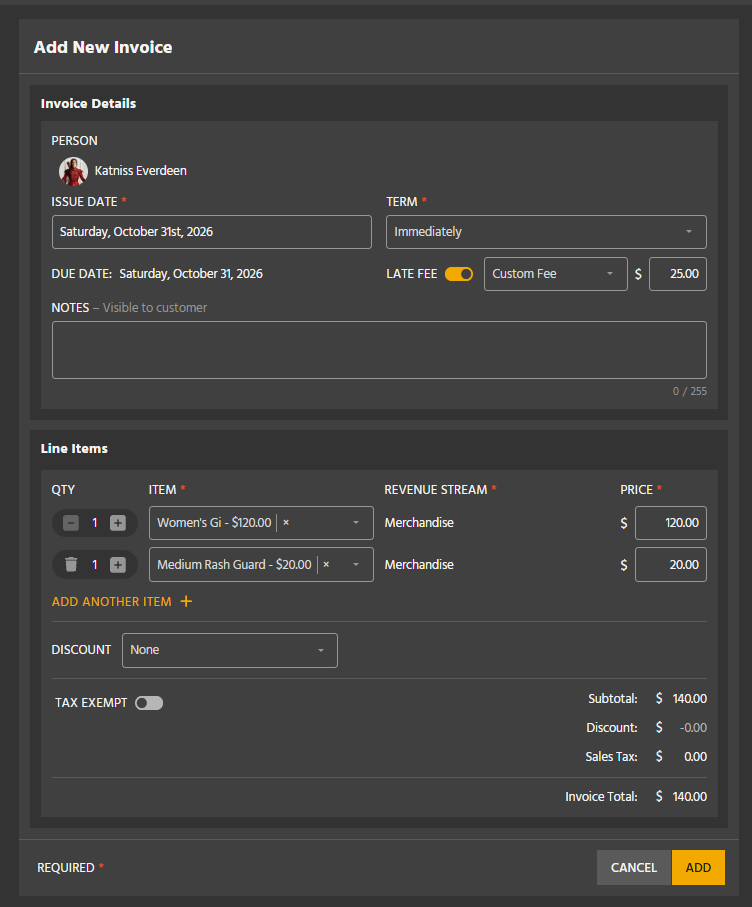
Building the invoice
- Issue Date — defaults to today.
- Term — when payment is due. Defaults to Immediately, which means end of day today. The Due Date updates as you change it.
- Late Fee (optional) — choose from the dropdown, or pick Custom Fee and enter an amount. A late fee is charged once, when the invoice goes past due, and arrives as a separate FEE invoice attached to this one so the full amount can be paid together.
- Notes (optional) — anything you want recorded on the invoice itself. Your Finances Settings may already supply a default note.
- Line items — pick from Select an Inventory Item, or type directly into the field to add a custom item that isn’t in your inventory. Adjust Qty as needed.
- Add Additional Item + — repeat for as many items as the invoice needs.
- Discount — choose from your list of eligible Discounts.
- Tax Exempt (optional) — toggle on if nothing on this invoice should be taxed.
Sales tax calculates automatically from your Finances Settings.
Click Add when the invoice is right.
Taking payment
You will be directed to the details after adding the invoice, or find the invoice on the Open tab (on the student profile or the finances page).
- Click Pay.
- For a partial payment, change the amount in Payment Amount. It defaults to the full balance.
- Click Choose Payment.
- Pick the Payment Type. If it’s a card and the person has more than one saved, select the right one.
- Click Pay Now.
If the invoice includes a physical item the customer is taking home, click Mark Delivered to update your inventory and keep your stock counts accurate.
A fully paid invoice moves to Closed. A partial payment leaves it Open with the remaining balance.
Troubleshooting
The item I need isn’t in the dropdown. Either it isn’t in your inventory yet or its category is filtered out. You can type any name directly into the field to add it as a one-off line item without adding it to inventory.
Tax came out wrong. Tax comes from Retail Invoice Details in Finances Settings, and an inventory category can override it. Check the category before assuming the invoice is at fault.
The late fee never appeared. Late fees generate when the invoice actually goes past due, not when you create it. If the Term is Immediately, the fee appears the following day.
My stock count is wrong. Look for paid invoices on the Undelivered tab. Inventory only moves when you click Mark Delivered.
Limitations
- Once you reduce an invoice’s balance, it can no longer be voided.
- Invoices can’t be deleted. Void one that was never paid, adjust the balance on one that was, and archive it once it’s closed.
- Discounts can’t be applied to an invoice after it’s been created.