How to Use the Prospect List
The Prospect List is your pipeline. It shows everyone who might join, grouped by how far along they are, so you can see at a glance who needs to be followed up with.
There are two ways to look at it — a board for working the pipeline, and a table for sorting and exporting. Switch between the views with the icon in the upper right; your filters carry across both formats.
Get to the Prospect List via Profiles → Prospects in the left panel, or search Quick Links.
Stages
Each column is a stage — a step towards becoming a student. Every school starts with the same defaults:
| Stage | What it Means |
| Lead | Where new prospects land, added by hand or online. |
| Qualified | Confirmed as real and worth pursuing. Schools opened before July 2025 don’t have this by default; you can add it. |
| Appointment | Booked to visit. Set automatically when you schedule an appointment. |
| Trial | On a trial membership. Set automatically when you create one. |
| Archived | Not pursuing, but keeping the record. Table view only, to keep the board clean. |
Customizing Stages
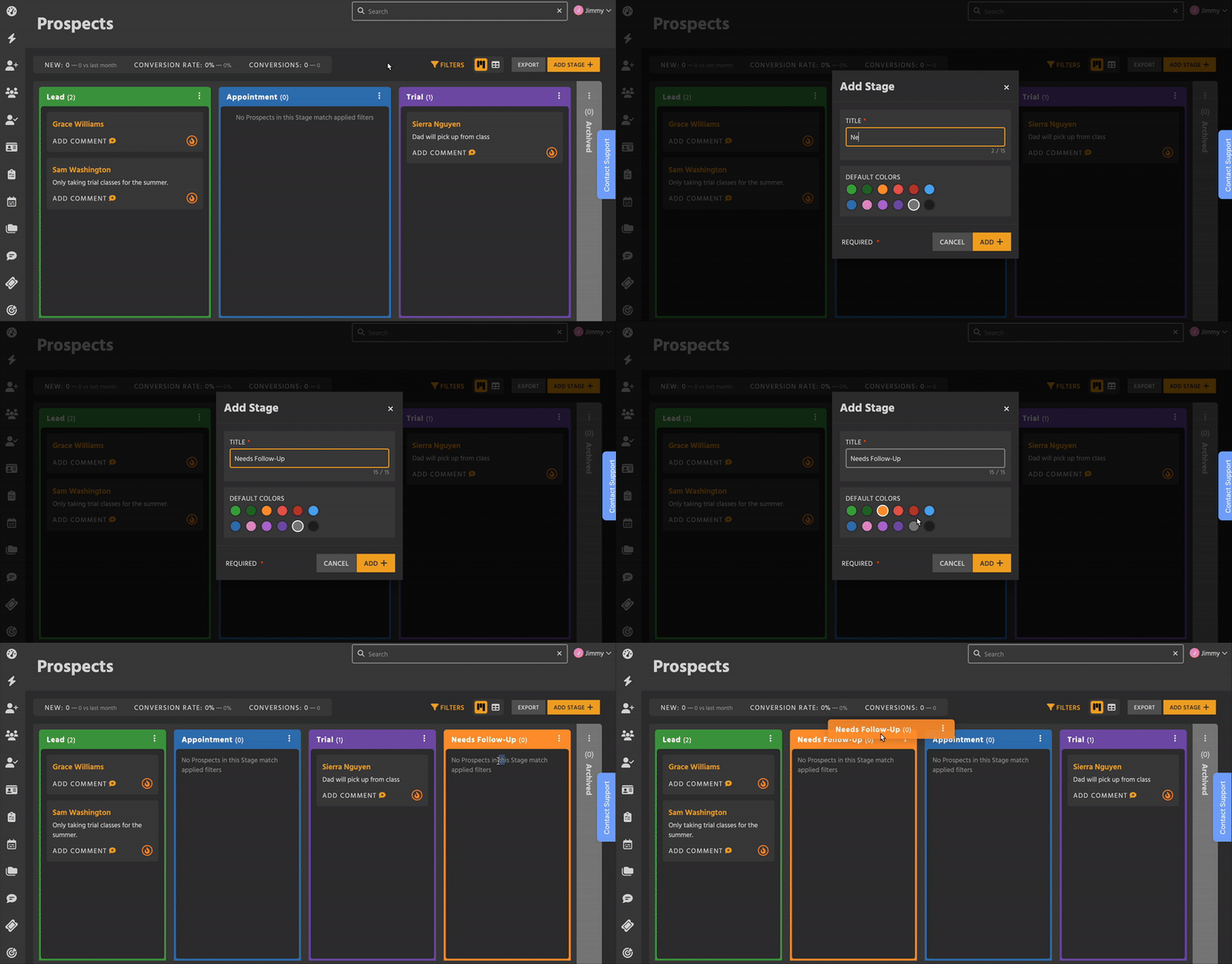
Rename any stage, change its color, add new ones, and drag columns to reorder. A school with a longer sales process might add “Contacted” and “Follow Up” between Lead and Qualified.
Click Add Stage in the upper right of the board to create one. Names are capped at 15 characters.
The color you choose appears throughout Kicksite — set Trial to pink and everyone on a trial carries a pink dot wherever you see them.
Two stages are locked:
- Lead can’t be moved or deleted, because new prospects have to land somewhere. You can rename it.
- Trial can’t be deleted, because trial memberships depend on it.
Delete the Appointment stage and you lose its automatic behavior. Recreate it later and it comes back as an ordinary column — scheduling an appointment will no longer move anyone into it.
Priority
A Prospect’s priority is independent of stage and is often the better guide to who to call today.
- Hot (red flame) — ready to decide. Move slowly and they’ll go elsewhere.
- Warm (orange flame) — interested, no urgency. The default for everyone.
- Cold (blue snowflake) — little interest so far, needs real follow-up.
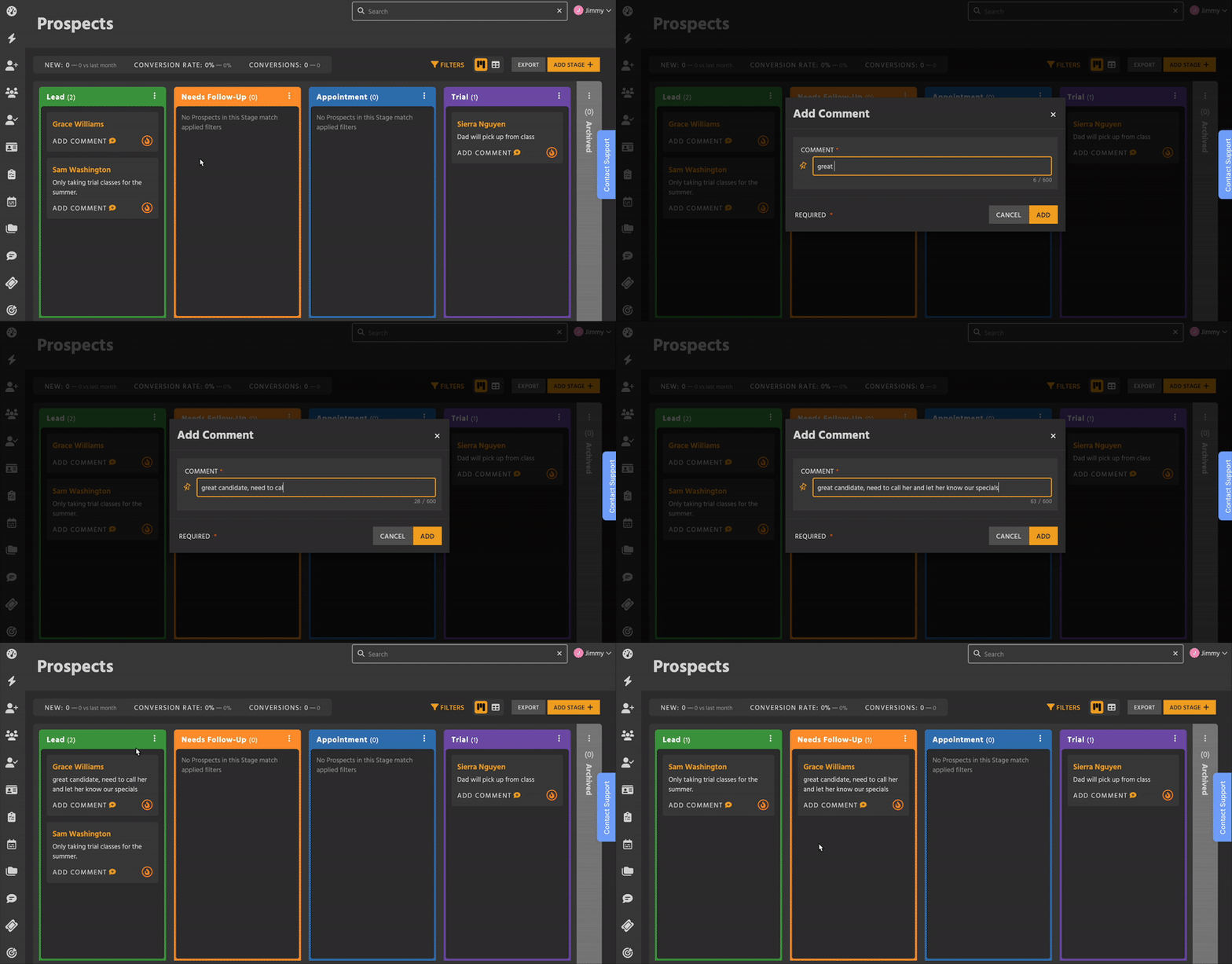
Click the icon at the bottom right of a card to change it, or set it on their profile.
Board View
The board is the default view, and where the daily work happens. Use it to move people along, see who’s stuck, and get the shape of the pipeline.
Drag cards between columns to change a Prospect’s stage. Some columns act when you drop someone in — Trial asks for a trial membership, Appointment opens the scheduling window.
Click a column heading to jump to the table filtered to that stage.
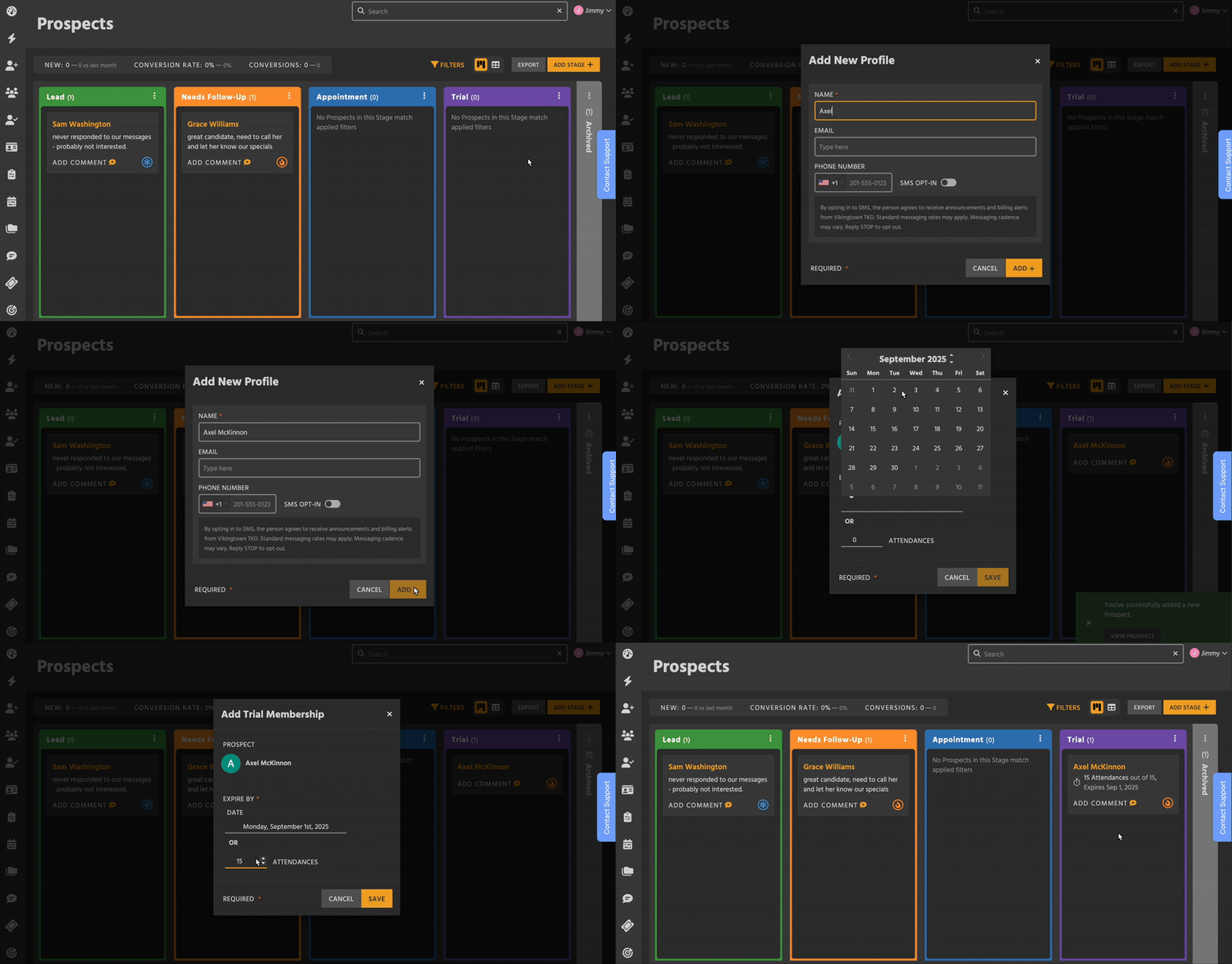
Table view
The table view is best used for sorting, exporting, and managing archived prospects. Sort by name or stage. It’s the only place archived prospects appear.
Actions on a whole column
Click the kebab in a column header.
- Add a Prospect — creates them in that stage.
- Show on Card — choose what appears on each card: the most recent comment, the next appointment, or time left in trial. Admin only. Setting the Trial column to show time remaining is worth doing on day one.
- Edit Stage — name and colour.
- Send Email / Send SMS — an announcement to everyone in the column. People without an email address, without a phone number, or who’ve opted out of texts, are skipped. SMS needs an SMS integration.
- Move left / right — or drag the header.
Column actions respect your filters. Filter to Hot prospects and “Send Email” reaches only those, not the whole column.
Actions on one prospect
Right-click a card, or hover and click the kebab.
- Change Stage — same as dragging, and it triggers the same prompts.
- Convert to Student — ends any trial membership and makes them an Active student. Their prospect history stays in the History module.
- Assign To — give an employee ownership. The employee is notified via email.
- Schedule Appointment / Schedule Task.
- Send Email / Send SMS — to just that person.
- Archive — for people who won’t be back, never signed up, or have been sitting there over a year.
Filters
Click Filters in the upper right. Multiple selections within a filter are additive, and filters persist when you switch views. Clear resets everything.
- Date range — when the prospect was created.
- Source — how they arrived. Landing Pages show as LP, Lead Capture Forms as LCF.
- Assigned to — which employee owns them.
- Stage — most useful in table view. To see archived prospects, tick only Archived.
- Priority — Hot, Warm, Cold.
If a column empties out because nobody matches, you will see a message in the column: “No Prospects in this Stage match applied filters.”
On the Dashboard
Two modules mirror this list.
- Pipeline — headcount per stage, split by priority, plus new prospects in the last 7 days. Click an arrow to open the board filtered to that stage; click a priority icon to narrow further. Change the date range under Customize Dashboard.
- Distribution — a pie chart of stage and priority spread.
Troubleshooting
A prospect vanished from the board. They were archived. Archived prospects only appear in table view.
The appointment window didn’t open when I dragged someone into Appointment. The stage was deleted and recreated at some point, which loses the automatic behaviour.
Send SMS is missing. Your school has no SMS integration, or the prospect has no phone number or has opted out.
I can’t delete a stage. Lead and Trial are locked. Others can be deleted, but move anyone in them first.
Send Email reached fewer people than I expected. Filters were applied, or some prospects have no email address. The confirmation screen lists who was skipped and why.
Limitations
- Prospects can’t be merged. Merging is only available between a Contact and a Student.
- Archived prospects are hidden from board view by design.
- Stage names are capped at 15 characters.